

23 Sep Using Your Core Values to Make Decisions
Using Your Core Values to Make Decisions
Why a short list of values beats a long list of rules — in business and at home
4 minute read
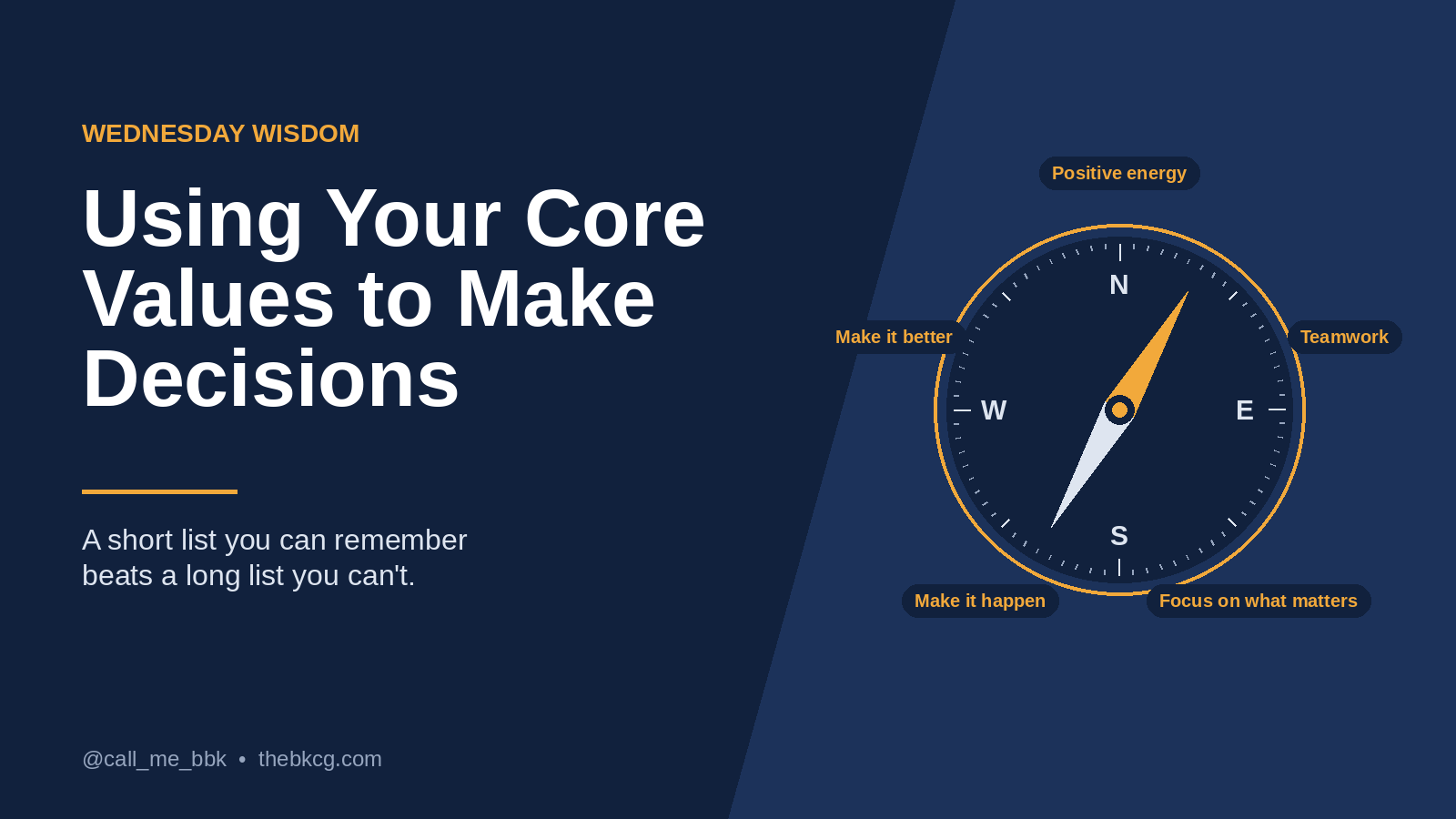
“Your core values are your compass. Run every decision through them, and the right answer gets a lot clearer.”
I recorded the video below on St. Patrick’s Day a few years back, sitting in my living room, because I wanted to talk about something that has shaped every business I’ve built and most of the personal decisions I’ve made along the way: core values.
It’s a simple concept. But simple doesn’t mean easy, and it doesn’t mean unimportant. Here’s how I think about it.
One set of values for your whole life
I’ve been lucky in one respect. The values I believe in have crossed over cleanly between my personal life and my professional life. They’ve been closely aligned from the start, which means I don’t have to switch compasses when I walk into the office.
Those values guide me when I’m planning for a business. They guide me when I’m thinking about how to do better as a husband, a father, or a friend. And in business they show up in very practical ways:
- Hiring. When I’m evaluating a candidate, I think about the company’s core values and my own, and I use them to decide how that person will fit.
- Product decisions. When we’re designing a feature, we run it through our core values to make sure we’re making the right call, not just the profitable one.
- The business itself. Every company I’ve been part of has needed to be about more than money. Whether it was student health records, patient communication between hospitals and physicians, or simulations that help principals and educational leaders manufacture experience, the work had to make a difference. That’s what drives me.
What it looked like at Magnus Health
At Magnus Health, we developed our core values in 2016. I worked on them with the interim CEO before I stepped into the CEO role myself, and they were deliberately basic:
- Positive energy
- Teamwork
- Focus on what matters
- Make it happen
- Make it better
Nothing groundbreaking. But they were easy to remember, easy to understand, and they had real impact. That last part was the goal. We wanted every employee to know the values, to be able to repeat them, and to use them to make decisions the same way we did at the management level. A value that lives on a poster in the lobby and nowhere else isn’t a value. It’s decoration.
“Make it better” — including yourself
One of those values, make it better, is something I try to apply to myself every day and every week. I look back at some prior period and ask whether I did a little better than I did before. Better than yesterday. Better than last month.
I’ll admit a flaw here. I tend to dwell on mistakes. I can beat myself up over one and focus on it far too long. That’s not what I want to do, and it’s not what I’d want for you either. The better move is to treat the mistake as a challenge, learn from it, and do better next time. Try not to make the same mistake twice. Use it to improve, not to punish yourself.
I have to work hard at that one. But it’s exactly the kind of thing a written value helps with, because it gives you something to point to when your instincts pull the other way.
How to start building your own
If you don’t have a set of core values yet, don’t overthink it. Start simple.
- Ask what’s important to you. Jot down the first few things that come to mind. Even the first thing.
- Make that your focus. Run your decisions through it. Run the opportunities that come your way through it, whether that’s a job you’re considering or a person you’re deciding whether to spend time with.
- See how it works. Then build from there.
Your list shouldn’t be twenty items long. It should be short enough that you can remember it and think about it in your daily life. Once you have it, it becomes your compass, a set of guiding principles you can use without having to reinvent your reasoning every time.
Small steps, real change
This is a message I find myself repeating to people all the time: start small. You can’t bite off more than you can chew, and you can’t solve the world’s problems in a day. Take little steps. Make progressions forward. Do the best you can.
Those small, incremental changes add up. You won’t notice the difference day to day. But a year from now you’ll look back at who you were, how you operated, and what you cared about, and you’ll see major change that happened without you ever feeling it in the moment.
That’s the whole idea. Set a few values that matter to you. Run your decisions through them. Get a little better each day.
If you want to talk through your own values, or how to build them into a company, reach out. I’m always happy to have that conversation.
@call_me_bbk
———————————————————————————————————————————————-