

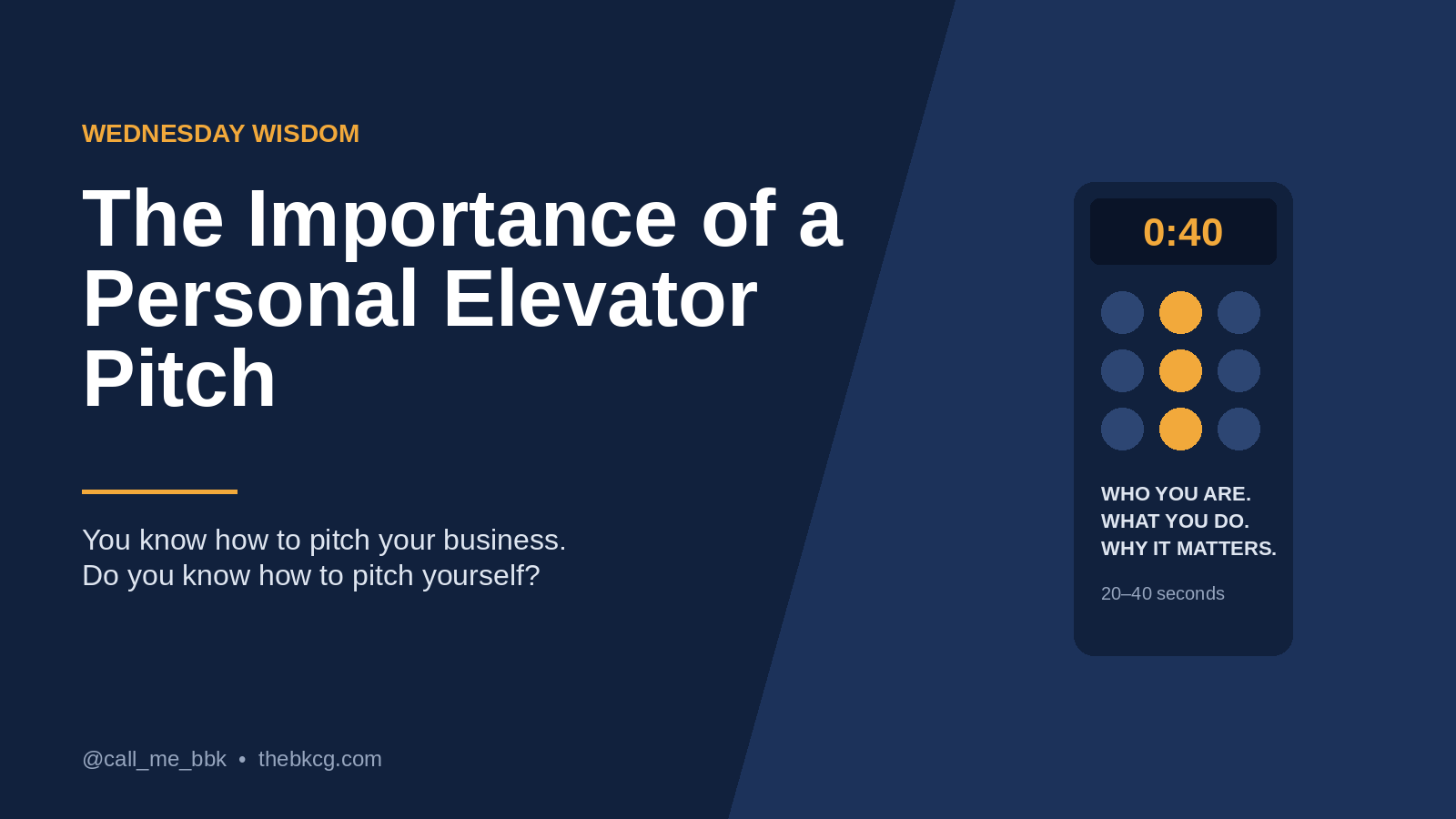
23 Sep The Importance of a Personal Elevator Pitch
The Importance of a Personal Elevator Pitch
You already know the value of pitching your business. Here’s why you need one for yourself.
4 minute read
“Your elevator pitch is a 20-to-40-second story that tells people who you are and what your value is. Every conversation about you starts there.”
Most people in business are familiar with the elevator pitch. You build one when you’re trying to raise money or get acquired. It’s the compressed version of your company: what it does, why it matters, why someone should care.
I believe creating a personal elevator pitch is equally important, and far fewer people bother to do it.
What it is
Your personal elevator pitch is a story you can tell in 20 to 40 seconds. It clearly explains who you are and what your value is. And it’s useful in far more situations than an investor meeting:
- A business meeting where you’re introducing yourself to the room
- A job interview, where “tell me about yourself” is almost always the first question
- Meeting a new person, whether that’s a potential client, a new colleague, or someone who might become a friend
Whenever you’re asked about yourself, you can use that opening 20 to 40 seconds to bring confidence to how you come across and clarity to who you are and what you’re about. That confidence carries through the rest of the conversation. That’s the real goal.
One thing to know going in: your elevator pitch will always be changing. Your story evolves as you go through life. The version you’d tell in high school is different from the one in college, which is different from the one when you’re starting your career, which is different again ten years in. Every time you interview, every phase you enter, the pitch changes with you. That’s fine. It’s supposed to.
My elevator pitch
Here’s the one I was using when I recorded the video above, and I’m still pretty proud of it:
My name is Brian Biddulph-Krentar, and I’ve been starting companies for 15 years. My experience started in healthcare technology. The first business I started was a consulting company, but I quickly shifted to SaaS, software-as-a-service, and I’ve been doing that since 2009. I’ve been lucky enough to generate ideas that intersected my professional experience with my personal world, and I really believe that’s what led to my success, because my why was very clear. The reason I started those businesses was impactful to me personally and professionally. Despite being a serial entrepreneur, I’m actually lucky enough to still be married, and I have two awesome kids. I love coaching their soccer teams, and I still play in multiple leagues several times a week, like I’m pretending I’m still in my twenties.

What’s in it, and why
If you look closely, that pitch has three distinct pieces, and each one is doing a job.
1. Professional experience. What I’ve done, how long I’ve done it, and the thread that connects it. This is the “what is your value” part. Keep it tight; you’re not reciting a résumé.
2. Something personal. My family, my kids, soccer. This is what makes me a person instead of a title. People connect with people.
3. A little humor at the end. The line about pretending I’m still in my twenties is self-deprecating on purpose. Ending with a laugh gets people to drop their shoulders and drop their guard. When someone smiles, the rest of the interaction goes better. If you can get people off their guard in the first 40 seconds, you’ve already won the conversation.
There’s also a bit of foreshadowing in there. I mention my “why” without explaining it, which is deliberate: it invites the next question. If you’re curious what I mean by that, I wrote about it in Start With Why.
How to build yours
This is common sense to a lot of people, but it takes more work and effort than it appears. A few suggestions:
- Write it down. Don’t wing it. A pitch that lives only in your head comes out differently every time.
- Practice in front of a mirror. This is your personal story, and you are your own worst critic. You need to feel good about it and feel confident in what you’re going to say, because that confidence is what people actually respond to.
- Practice makes perfect. Say it out loud until it sounds like you talking, not you reciting.
- Revisit it as your story changes. New role, new company, new chapter: update the pitch.

It’s a small thing. But the first 40 seconds of every introduction you’ll ever make are going to happen whether you’ve prepared for them or not. You might as well nail them.
If you want a second set of eyes on your pitch, send it to brian@thebkcg.com. I’d be happy to read it.
@call_me_bbk
———————————————————————————————————————————————-